
We find where the water gets in before anyone says new roof.
GA Roofing & Repair is an Atlanta roofing company that does roof repair first and replacement second, on houses and on commercial buildings. Every job starts with a ladder, a flashlight in the attic and a camera.
Who runs this site
A roofing contractor, based on West Peachtree.
This site is run by Garoofingandrepair, trading as GA Roofing & Repair at garoofingandrepair.co. We are a residential roofing contractor in Atlanta that also takes on low-slope commercial roofs. The office is at 1201 W Peachtree St NW, Atlanta, Georgia 30309, United States.
We are not a general builder and we are not a lead site that sells your name to three other roofers. When you call or send the form, it lands with the people who will climb your roof. Gutters, siding and kitchens are other trades. We point you elsewhere for those.

The crew
The crew that tears off is the crew that dries in.
We do not hand your roof to whoever is free that morning. The people who strip the old shingles are the same people who lay the underlayment and close the job before the afternoon storm rolls in. They know what they found under the old layer because they found it.
On a repair, the person who inspects is usually the person who comes back to fix it. That matters more than it sounds. Nobody has to translate a photo into a guess.
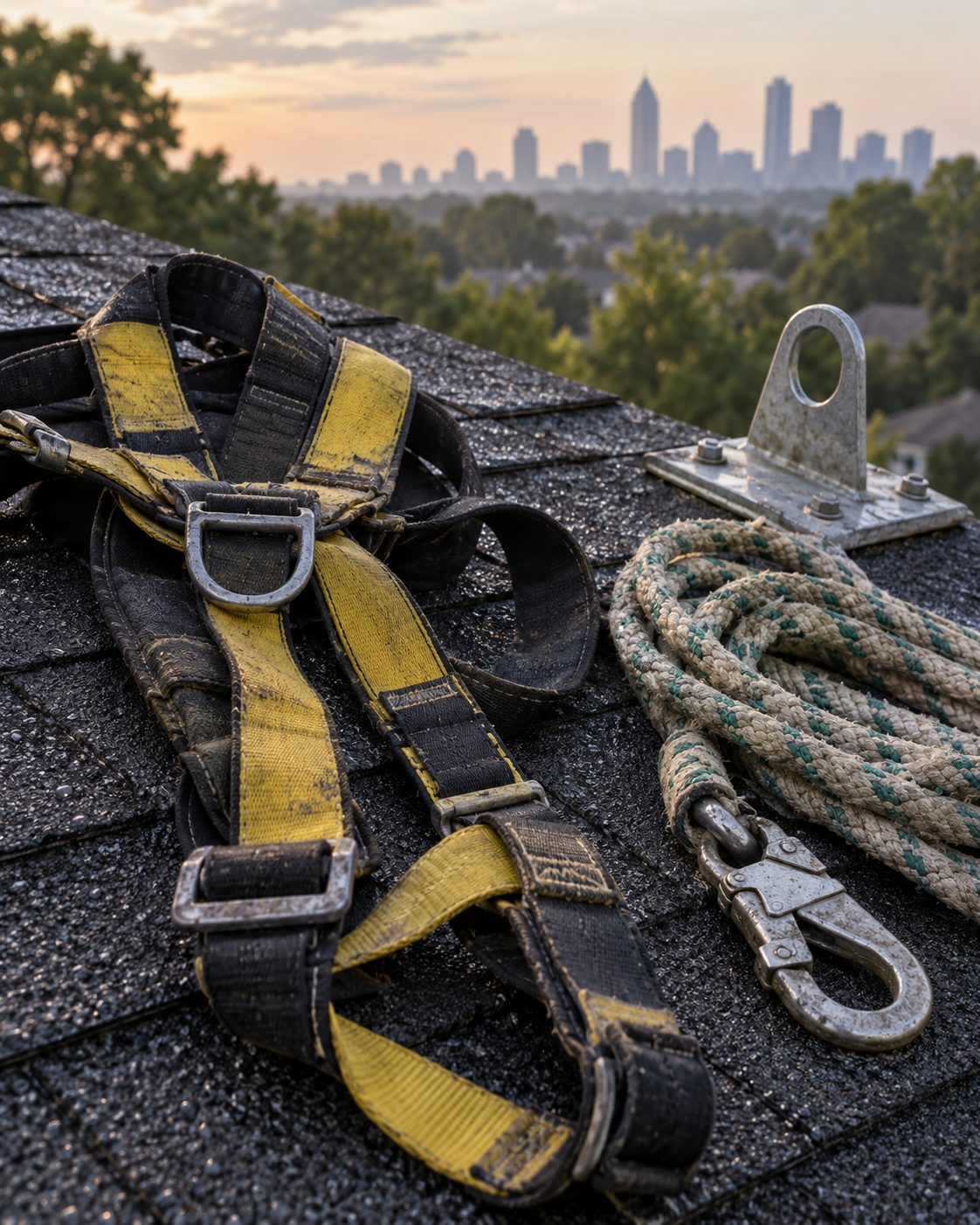
Harnesses go on for anything steeper than a walkable pitch, and the job ends with a magnet sweep of the yard. That sweep is not optional. Roofing nails in a driveway are how a roofer gets a bad name.
How a job runs
Diagnosis on the roof, then a written scope, then the work.
What we actually do: roof leak repair, chimney and step flashing, storm and wind damage repair with a photo report, full tear-off and re-roof on pitched houses, and TPO or modified bitumen on low-slope commercial roofs. Here is the order it happens in.
-
Phone call
You call 770-639-7663 or send the form. We ask three things: where the water shows up inside, how old the roof is if you know, and whether it is pitched or flat. If it is raining into a bedroom right now, we say so and we talk about a tarp first.
-
Attic first
Before the ladder, the attic. Water stains on the underside of the decking, wet insulation, daylight around a pipe, black mold on the north slope from poor ventilation. A stain on the ceiling is often two or three feet downhill of the real entry point. The attic tells you where to look up top.
-
On the roof
We walk it. Pipe boots with cracked rubber collars, step flashing that was face-nailed and caulked, valleys where the shingles were cut short, nail pops, lifted tabs on the windward side. Every finding is photographed with something in frame for scale. You get the photographs, not a description of them.
-
Written scope
A repair gets a single written price for that repair. A replacement is priced per square, which is 100 square feet of roof, plus decking replaced per sheet. The scope names the tear-off depth, the underlayment, ice-and-water shield in the valleys, flashing, ventilation and haul-away. If it is not written down, it is not in the price.
-
The work
Repairs are usually a single visit. A typical house re-roof runs one to three working days depending on the squares, the pitch and what the decking looks like once the old shingles are off. Soft plywood is cut out sheet by sheet and the count is on your invoice.
-
Close-out
Magnet sweep, gutters cleared of granules and debris, dumpster gone. You get the after photographs to file with the before ones. If your insurer is involved, they get the dated report with both.
Why repair first
Most Atlanta leaks are not a worn-out roof.
Most leaks we trace on Atlanta homes start at a pipe boot, a valley or a chimney. Not the shingles. A 15-year-old architectural shingle field with a split neoprene boot does not need a new roof. It needs a new boot, and maybe the two courses of shingle around it.
We also tell you when a repair is not enough. If the decking flexes under a boot, if three slopes have granule loss down to the mat, if the last roofer laid a second layer over a failed first, patching is money in the gutter. You will see the photograph that made us say it.
Roof inspection in Atlanta should end with a decision you can make yourself. That is the whole point of the photographs.
Atlanta roof conditions
What this city does to a roof.
Attics that cook
A dark shingle in a Georgia July runs far hotter than the air. Without enough intake at the soffit and exhaust at the ridge, the attic bakes the shingles from underneath and the adhesive strips let go early. Half the "bad shingle" calls we get are ventilation calls.
Needles in the valleys
Loblolly pines drop needles all year. They pack into valleys and behind chimneys, hold water against the shingle and rot the edge of the decking. A clogged valley is a slow leak that shows up three years later as soft plywood.
Wind and hail in an afternoon
Thunderstorms build fast here. Gusts lift tabs and break the seal, and once a shingle has creased it will not lie flat again. We tarp in the storm when we can reach you, and then we come back. A tarp is a two-week fix.
Damp that never leaves
Clay holds water, crawlspaces stay humid, and that moisture rises into poorly vented attics. North slopes under tree cover grow moss and algae streaks. On older brick homes, the mortar at the chimney goes soft and the flashing loses its grip.
Things we refuse to do
Four shortcuts we turn down, even when asked.
Every one of these is cheaper on the day. Every one of them is a callback, or a voided warranty, or rot under a roof that looks fine from the street.
- Lay a second layer of shingles over a failed first one.
- Re-use rusted step flashing because it is already bent to fit.
- Run a bead of caulk around a chimney and call it flashed.
- Quote a full replacement from a drone photo without walking the roof.
A+
An A+ BBB rating, and how we keep it.
The A+ BBB rating is the one credential we put our name to on this site. You can look it up yourself with the Better Business Bureau before you call us. We would rather you did.
We keep it the plain way. Written scopes, so nobody argues later about what the price covered. Photographs before and after, so nobody argues about what was found. And when something we did fails, we come back and look at it.
Materials we install
Named products, not "premium shingles".
On pitched roofs we install architectural asphalt shingles from GAF, Owens Corning and CertainTeed, over synthetic underlayment, with ice-and-water shield in every valley and around every penetration. Step flashing is new galvanized steel, one piece per course. Pipe boots are replaced, not caulked.
On commercial low-slope work we install TPO single-ply from Carlisle and Firestone with hot-air welded seams, and modified bitumen where the building and the budget suit it better. We name the product on the scope so you can read its spec sheet.
- GAF
- Owens Corning
- CertainTeed
- Carlisle TPO
- Firestone TPO
- Modified bitumen
- Synthetic underlayment
Reach a person
Call. Someone who has been on a roof this week answers.
Phone is fastest. If nobody picks up, it is because the person with the phone is on a ladder. Leave the address and where the water is showing and we call back. Email and the form are read by the office on working days and answered by a person, not an autoresponder.